
Views: 0 Author: Site Editor Publish Time: 2026-06-16 Origin: Site


Ever wonder how machines balance speed and power? Gear ratio holds the key. It controls how fast or strong a gear system runs. In this post, you’ll learn what gear ratio is, why it matters, and how it affects speed and torque.
Table of Contents
Gear ratio compares how fast one gear turns relative to another. You calculate it by dividing the number of teeth on the output gear by the number of teeth on the input gear. For example, if the input gear has 20 teeth and the output gear has 60 teeth, the gear ratio is 60 ÷ 20 = 3:1. This means the input gear must turn three times to make the output gear turn once.
Another way is by comparing the diameters of the gears. Since the circumference (distance around) of a gear relates directly to its diameter, a gear twice as large in diameter will turn half as fast. So, a 6-inch diameter gear driving a 3-inch diameter gear also gives a 2:1 ratio.
Counting gear teeth is usually more precise than measuring diameter because teeth prevent slippage, ensuring exact speed ratios.
The number of teeth and diameter work together to define the gear ratio. Gears with more teeth generally have larger diameters. The ratio of teeth between two gears directly affects how speed and torque transfer.
More teeth on output gear: output turns slower but with more torque.
Fewer teeth on output gear: output turns faster but with less torque.
Teeth keep gears synchronized, preventing slip, which makes the gear ratio consistent even if the gear diameter varies slightly due to wear or manufacturing differences.
Different gear types influence gear ratios and how power transfers:
Spur Gears: Simple, straight teeth, used for parallel shafts. They provide straightforward gear ratios based on teeth count.
Helical Gears: Teeth cut at angles, offering smoother and quieter operation, often used in automotive transmissions.
Bevel Gears: Cone-shaped gears that transfer motion between intersecting shafts, changing rotation direction and speed.
Worm Gears: Consist of a screw-like worm engaging a gear. They create very high gear ratios in compact spaces, ideal for applications needing large torque at low speeds.
Planetary Gears: Complex gear sets with sun, planet, and ring gears. They offer multiple gear ratios in a compact form, commonly found in automatic transmissions and robotic joints.
Each gear type suits different needs, affecting the achievable gear ratios and mechanical advantages.
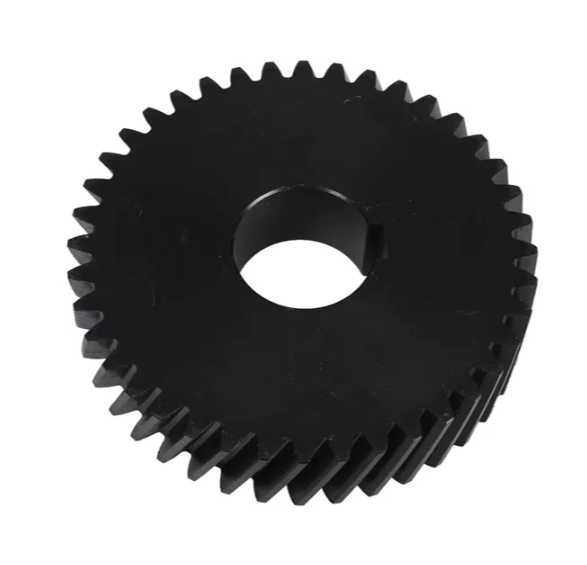
Gear ratio creates a balance between speed and torque. When one increases, the other decreases. This inverse relationship means if speed goes up, torque drops, and if torque rises, speed slows down. It’s a fundamental concept in gear systems because gears trade one for the other to match mechanical needs.
For example, if a gear system is set to boost speed, it sacrifices torque. Conversely, if it’s designed to increase torque, speed will reduce. This trade-off allows machines to perform specific tasks more effectively by adjusting their gear ratios.
Higher gear ratios (like 4:1 or 5:1) mean the output gear turns slower than the input gear. This slowdown boosts torque at the output shaft. Essentially, the motor’s twisting force multiplies, helping it push or pull heavier loads.
Speed Reduction: Output speed is lower because the larger output gear turns fewer times per input revolution.
Torque Increase: Torque multiplies by the gear ratio, enabling stronger force application.
Use Cases: Heavy machinery, climbing steep hills in vehicles, or lifting equipment use high gear ratios to get more power.
A 4:1 ratio means the input gear spins four times for every output gear rotation, multiplying torque by four but reducing output speed to one-quarter of the input speed.
Lower gear ratios (like 1:4 or 1:3) do the opposite. The output gear spins faster than the input gear, increasing speed but decreasing torque.
Speed Increase: Output gear rotates multiple times for each input gear turn.
Torque Reduction: Torque decreases proportionally.
Use Cases: Applications needing higher speeds but less force, such as bicycles, conveyor belts, or automotive transmissions in higher gears.
For example, a 1:4 ratio means the output gear turns four times for every input gear turn, quadrupling speed but cutting torque to a quarter.
Bicycle Gears: When you shift to a higher gear, pedaling speed increases but it feels harder because torque decreases. Lower gears make pedaling easier but slower.
Car Transmission: Lower gears provide more torque to start moving or climb hills, while higher gears increase speed on highways with less torque.
Industrial Machines: A crane uses high gear ratios to lift heavy loads slowly, while a packaging machine might use low gear ratios to run faster but with less force.
Understanding these effects helps engineers pick the right gear ratio for a task, balancing speed and torque to optimize performance.
Gear trains are a series of gears connected together to transmit motion and power from one shaft to another. They let us achieve gear ratios not possible with just two gears. By combining multiple gears, gear trains can increase or decrease speed and torque beyond simple gear pairs.
The main purposes of gear trains include:
Changing the direction of rotation
Increasing or decreasing speed
Increasing or decreasing torque
Transferring motion to different axes
For example, a gear train can convert a fast-spinning motor output into slower, more powerful motion for lifting heavy loads. They also help synchronize rotations between distant shafts.
When a single pair of gears can't provide the needed ratio, gear trains come to the rescue. By connecting several gears in sequence, you multiply the individual gear ratios.
If one gear pair has a 3:1 ratio and the next also 3:1, the total gear ratio becomes 3 × 3 = 9:1. This means the output gear turns once for every nine input rotations, greatly increasing torque while reducing speed.
Gear trains can be arranged in various ways:
Simple Gear Train: Gears connected in a single line.
Compound Gear Train: Gears mounted on the same shaft, combining ratios.
Reverted Gear Train: Input and output shafts aligned, common in clocks.
This flexibility allows designers to tailor gear ratios precisely to application needs.
Planetary gear systems, also called epicyclic gears, consist of three main parts:
Sun Gear: Center gear.
Planet Gears: Multiple gears orbiting the sun.
Ring Gear: Outer gear with internal teeth.
This setup offers compact size and high torque capacity. Planetary gears provide multiple gear ratios by changing which part is the input, output, or held stationary.
Key features include:
High torque density in small space.
Smooth power transmission.
Ability to reverse output direction.
Multiple gear ratios using the same components.
They’re common in automatic transmissions, electric screwdrivers, and robotics.
Gear trains appear in many machines we use daily:
Automotive Transmissions: Combine gear trains and planetary gears to provide different speeds and torque.
Clocks and Watches: Use gear trains to translate fast spring unwinding into slow, precise timekeeping.
Power Meters: Mechanical dials connected by gear trains to measure electricity usage.
Bicycles: Gear trains in derailleurs adjust pedaling effort and speed.
Industrial Machines: Conveyors and lifts rely on gear trains to handle loads efficiently.
Each application uses gear trains to optimize performance by balancing speed and torque for the task.
Gear ratio directly changes motor speed and torque output. When you increase the gear ratio, the output speed drops, but torque rises. This means a motor spinning fast but weak can deliver slower, stronger force after gearing.
For example, a 5:1 gear ratio means the motor shaft turns five times for each output shaft turn. The output speed is one-fifth of the motor speed, but torque multiplies by five. This helps machines handle heavier loads without needing a larger motor.
On the flip side, a lower gear ratio increases output speed but cuts torque. This suits applications needing fast movement but less force, like conveyor belts or fans.
Efficiency varies with gear ratios. Higher gear ratios often mean more gear teeth mesh, increasing friction and energy loss. This can cause heat buildup and reduce overall system efficiency.
Also, complex gear trains with high ratios may have more moving parts, increasing mechanical losses. Designers balance gear ratio benefits against these efficiency drops.
Proper lubrication, precise gear manufacturing, and quality materials help minimize losses. Choosing the right gear ratio for the task avoids unnecessary energy waste.
Higher gear ratios affect accuracy and load handling. They can amplify backlash—the small gap between gear teeth—which reduces positioning precision. This matters in robotics or CNC machines needing exact movements.
Load handling improves with higher gear ratios since torque increases, allowing the system to manage heavier weights safely. However, response speed slows down because the output reacts more slowly to input changes.
Lower gear ratios offer faster response and better control but less torque for heavy loads. Selecting the right ratio depends on balancing these needs.
Gear ratio impacts noise and wear. Higher ratios mean more torque on gear teeth, increasing stress and potential wear. This can shorten gear lifespan if materials or design don’t handle the load well.
Noise often rises with higher torque loads, especially if gears aren’t precisely machined or lubricated. Conversely, lower gear ratios tend to produce less noise and wear, as forces on gears are smaller.
Regular maintenance, proper gear selection, and quality lubrication extend gear life and reduce noise.
Selecting the right gear ratio is crucial for ensuring your machine or device performs efficiently and reliably. It’s about matching the gear ratio to your specific needs—balancing speed, torque, control, and durability. Here’s how to approach it.
Begin by understanding the load your system must handle. This includes:
Starting Torque: How much force is needed to get the system moving from rest?
Operating Torque: The torque required during normal running conditions.
Peak Loads: Occasional or maximum torque demands during operation.
Choosing a gear ratio that provides enough torque to safely handle these loads prevents motor strain and mechanical failures. For heavy loads, a higher gear ratio increases torque but reduces speed, making it easier for the motor to move the load.
Next, define the desired speed range at your output shaft. The gear ratio directly affects output speed:
A higher gear ratio lowers output speed but boosts torque.
A lower gear ratio raises output speed but reduces torque.
Calculate the gear ratio by dividing the motor’s rated speed by the target output speed. For example, if your motor runs at 3000 RPM and you want an output speed of 500 RPM, a gear ratio of 6:1 fits.
Some applications need quick starts, stops, or precise positioning. Here, gear ratio impacts system responsiveness:
High gear ratios increase torque but slow response, potentially causing lag or less precise control.
Low gear ratios allow faster response and better control but less torque.
For robotics or CNC machines, avoid overly high ratios that amplify backlash or reduce accuracy. Balance torque needs against control demands.
Efficiency drops as gear ratios increase due to more gear teeth meshing and friction. High ratios may also cause more noise and wear, shortening gear life.
To optimize:
Choose the lowest gear ratio that meets torque and speed needs.
Use quality materials and precise manufacturing to reduce friction.
Maintain proper lubrication to minimize wear and noise.
This balance ensures good performance without sacrificing durability or wasting energy.

Worm gears use a screw-like shaft called a worm that meshes with a gear wheel. This design creates very high gear ratios in a small space. For example, if the worm has one thread and the gear wheel has 40 teeth, the gear ratio is 40:1. That means the worm must turn 40 times to rotate the gear wheel once.
Worm gears are great when you need large torque but limited space. They also provide a self-locking feature, preventing the gear wheel from driving the worm backward. This is handy in applications like lifts or conveyor systems, where holding position matters.
Planetary gear systems include a sun gear at the center, several planet gears around it, and a ring gear on the outside. This setup lets you achieve multiple gear ratios by changing which gear is the input, output, or held still.
Because the input and output shafts align on the same axis, planetary gears are compact and efficient. They handle high torque loads and provide smooth power transfer. You'll find them in automatic transmissions, electric screwdrivers, and robotics.
For instance, holding the ring gear stationary and driving the sun gear gives one ratio, but holding the sun gear and driving the ring gear produces a different ratio. This flexibility makes planetary gears ideal for complex gear systems.
Sometimes, connecting distant gears physically with shafts is impractical. Chains and belts serve as lightweight, flexible alternatives. They loop around sprockets or pulleys, transmitting motion over longer distances.
Chains are strong and resist slipping, making them suitable for heavy loads like motorcycle drives or bicycle transmissions. Belts, especially toothed ones, run quietly and smoothly and are common in automotive camshaft drives or office machinery.
These systems allow multiple gears or pulleys to be connected on a single chain or belt, offering versatility and ease of maintenance.
Worm Gears: Found in car windshield wipers, conveyor drives, and mechanical odometers.
Planetary Gears: Used in automatic car transmissions, electric screwdrivers, and robotic joints.
Chains and Belts: Present in bicycles, motorcycles, and timing systems in engines.
Each specialized gear type offers unique advantages in gear ratio design, space constraints, and mechanical performance.
Gear ratios play a vital role in how vehicles perform. In automotive transmissions, different gear ratios allow the engine to operate efficiently across a range of speeds and loads. Lower gears have higher gear ratios, providing more torque to help start moving or tow heavy loads. For instance, when towing a trailer, a vehicle uses a lower gear ratio to multiply torque, making it easier to pull the extra weight without straining the engine.
Higher gears have lower gear ratios, enabling the vehicle to cruise at high speeds with less engine effort. This balance between speed and torque ensures smooth acceleration, fuel efficiency, and power delivery. For towing, gear ratios around 3.73 to 4.10 are common, depending on the load size. A higher gear ratio means more torque but lower top speed, ideal for heavy towing.
In industrial settings, gear ratios are carefully chosen to match machinery tasks. Heavy equipment like cranes or conveyor systems use high gear ratios to increase torque, allowing them to lift or move heavy loads slowly and safely. Conversely, machines like packaging lines or fans need lower gear ratios for faster speeds but less torque.
Selecting the right gear ratio improves machine efficiency, reduces wear, and enhances control. For example, a crane’s gearbox might use a 10:1 ratio to multiply torque, while a conveyor belt might use a 1:3 ratio to increase speed. Engineers must consider the load, desired speed, and duty cycle when picking gear ratios to ensure optimal performance.
Robots rely heavily on gear ratios to balance speed, torque, and precision. High gear ratios increase torque, helping robots handle heavier payloads or resist external forces. However, too high a ratio can slow response time and reduce positioning accuracy due to gear backlash.
Robotic arms often use planetary gears because they provide compact size, multiple gear ratio options, and smooth power transmission. These gears help robots perform delicate tasks like assembly or surgery with precise control. Adjusting gear ratios allows engineers to customize robots for specific tasks, whether fast movement or heavy lifting.
Many common devices use gear ratios to function effectively:
Bicycles: Shifting gears changes the gear ratio, making pedaling easier uphill or faster on flat terrain.
Watches and Clocks: Gear trains reduce the fast unwinding of springs to slow, controlled movement of hands.
Electric Screwdrivers: Planetary gears increase torque in a small package for tightening screws efficiently.
Windshield Wipers: Worm gears provide high torque at low speeds to move the wiper blades smoothly.
Power Meters: Mechanical dials use gear trains to translate rotation into readable measurements.
These examples show how gear ratios enable devices to perform tasks suited to their purpose, balancing speed and force as needed.
Mastering gear ratio is essential for balancing speed and torque in mechanical systems. Proper gear ratio selection ensures efficient performance and durability. Innovations in gear design continue to enhance precision and power transmission. www.gears-manufacturer.com Dongguan Yongfeng Gear Co., Ltd. offers high-quality gears that deliver reliable, precise, and efficient solutions tailored to diverse applications. Their products help optimize machine performance while extending lifespan, making them a trusted partner in gear technology advancement.
A: Gear ratio compares the rotation speed of two gears and is calculated by dividing the number of teeth on the output gear by the input gear’s teeth.
A: Gear ratio inversely affects speed and torque; higher ratios increase torque but reduce speed, while lower ratios increase speed but decrease torque.
A: Selecting the right gear ratio balances load handling, speed requirements, and efficiency to optimize machine performance and durability.
A: Higher gear ratios can reduce efficiency due to increased friction and wear, so proper gear ratio selection and maintenance are essential.
A: Incorrect gear ratios can cause excessive wear, noise, and poor performance; ensuring proper ratio and lubrication helps prevent these problems.


