
Views: 0 Author: Site Editor Publish Time: 2026-06-16 Origin: Site


Have you ever wondered how machines transfer power so efficiently? Gear teeth are the hidden heroes in mechanical systems. They mesh precisely to transmit torque and motion without slipping.
In this post, you’ll learn what gear teeth are and why they are crucial for power transmission. We’ll explore how gear teeth interact to ensure smooth, efficient mechanical operation.
Table of Contents
Gear teeth are designed to fit together precisely, allowing one gear to turn another smoothly. When the teeth of one gear engage with those of another, they create a mechanical connection that transfers torque — the force that causes rotation — from the driving gear to the driven gear. This meshing action ensures power flows efficiently without slipping, unlike belt or chain drives. The shape and size of the teeth determine how well they mesh and how smoothly power is transmitted.

Primarily, gear teeth transmit rotational motion. When one gear rotates, it causes the adjacent gear to rotate as well, either in the same or opposite direction depending on their arrangement. However, gear teeth can also convert rotational motion into linear motion in specialized setups, such as rack and pinion systems. Here, the pinion (a small gear) meshes with a linear gear rack, turning rotational input into straight-line movement. This versatility makes gears invaluable in various mechanical systems, from steering mechanisms to conveyor belts.
The design of gear teeth directly impacts how speed, torque, and direction change during power transmission:
Speed: Gears with fewer teeth rotate faster, while those with more teeth rotate slower. This allows systems to increase or decrease rotational speed according to needs.
Torque: Torque is inversely related to speed in gear systems. A gear that slows rotation increases torque, providing more force to the output shaft.
Direction: The way gear teeth engage can change rotational direction. For example, two meshing spur gears rotate in opposite directions, while bevel gears can change the axis of rotation by 90 degrees or other angles.
The tooth profile — such as involute or cycloidal shapes — also affects efficiency and wear. Properly designed teeth reduce friction and noise, extend gear life, and maintain consistent power transmission.
Spur gears are the simplest and most common type of gear. They have straight teeth that run parallel to the gear’s axis. This straightforward design makes them easy to manufacture and highly efficient at transmitting power between parallel shafts. When spur gears mesh, their teeth engage all at once along the entire width, which can cause a bit of noise and vibration. Despite this, they are widely used because of their reliability and ability to handle high loads at moderate speeds. Applications include gearboxes, clocks, and conveyor systems.
Helical gears feature teeth cut at an angle to the gear’s axis, creating a helix shape. This angled design causes the teeth to engage gradually, starting at one end and progressing along the tooth length. As a result, helical gears operate more smoothly and quietly than spur gears. They also support higher loads due to the larger contact area between teeth. However, the angled teeth generate axial thrust forces, which require appropriate bearings to handle. Helical gears are common in automotive transmissions and industrial machinery where noise reduction and durability are important.
Bevel gears have teeth cut on a conical surface, allowing them to transmit power between intersecting shafts, usually at a 90-degree angle. Their teeth can be straight, spiral, or hypoid, each offering different performance traits. Straight bevel gears are simpler but noisier, while spiral bevel gears provide smoother operation and higher load capacity. Bevel gears are essential in applications like differential drives in vehicles, hand drills, and right-angle gearboxes, where changing the direction of rotation is necessary.
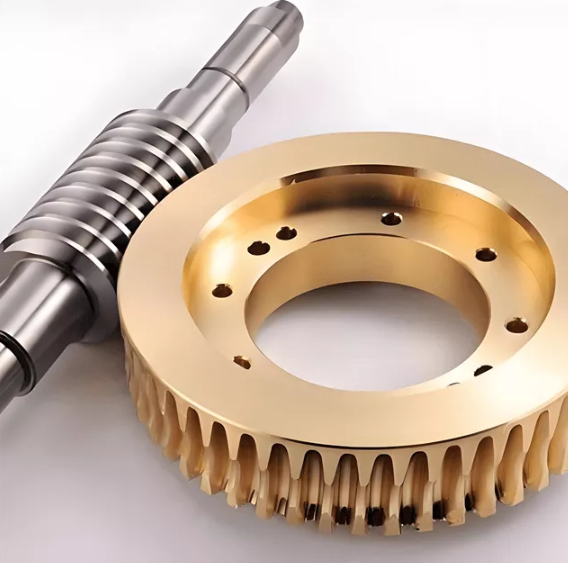
Worm gears consist of a worm (a screw-like gear) and a worm wheel (similar to a spur gear). This pairing allows for high gear reduction ratios in a compact space. The worm’s threads mesh with the worm wheel’s teeth, enabling smooth and quiet operation. One key advantage is their self-locking ability; the worm can turn the wheel, but the wheel cannot easily turn the worm, providing a braking effect. Worm gears are often used in conveyor systems, lifts, and tuning instruments. However, they tend to have lower efficiency due to sliding contact between the worm and wheel teeth.
Gear teeth must endure high stresses and constant contact, so material choice is crucial. Steel alloys are the most common materials, prized for their strength, toughness, and wear resistance. They handle heavy loads and high speeds well. Different steel grades, like carbon steel or alloy steel, offer varying hardness and durability depending on heat treatment.
Bronze is another popular choice, especially for worm gears or applications needing low friction. It resists corrosion and provides good wear properties, making it ideal for gears running in lubricated environments or where noise reduction matters.
Nylon and other engineering plastics serve in lighter-duty gears. They reduce noise, require no lubrication, and resist corrosion. However, they have lower load capacities and can deform under heat or heavy stress, so they’re best for low-torque, moderate-speed uses.
Manufacturing gear teeth precisely is essential for smooth power transmission. Hobbing is the most widely used process. It uses a cutting tool called a hob to progressively cut gear teeth, producing accurate and repeatable profiles. Hobbing suits mass production and various gear types.
Shaping is another cutting method where a reciprocating cutter shapes the teeth one at a time. It’s flexible for complex or custom gears but slower than hobbing.
Casting creates gears by pouring molten metal into molds. It’s cost-effective for large gears or low-volume production but results in lower precision and surface finish. Cast gears often need machining afterward to improve tooth quality.
3D printing is an emerging method for prototyping or producing complex gear shapes quickly. It allows rapid iteration but currently lacks the strength and surface finish of traditional methods for high-load applications.
The combination of material and manufacturing method directly affects gear life and efficiency. Steel gears made with precise hobbing and proper heat treatment offer long service life and high load capacity. Bronze gears reduce wear and noise in sliding contact applications but may have lower strength.
Plastic gears are quiet and corrosion-resistant but wear faster and deform under heavy loads. Casting may introduce porosity or surface defects, reducing durability unless followed by machining and heat treatment.
Manufacturing accuracy impacts how well gear teeth mesh. Poorly made teeth cause uneven load distribution, increased friction, noise, and premature wear. Proper finishing and quality control ensure smooth engagement and efficient power transmission.
Gear teeth provide one of the most efficient ways to transmit mechanical power. Because the teeth physically interlock, slipping is virtually eliminated, ensuring consistent torque transfer. This direct contact results in mechanical efficiencies often exceeding 95%, especially in well-designed steel gear pairs. Gears can handle very high loads, making them suitable for heavy machinery, automotive transmissions, and industrial equipment. Their ability to maintain torque under varying speeds and directions is unmatched by many other transmission methods.
Gears allow for compact power transmission setups. They can transmit large amounts of power in a relatively small space compared to belt or chain drives, which require more room for tensioning and alignment. This compactness benefits designs where space is limited, such as inside engines or gearboxes. Additionally, gears made from durable materials like hardened steel can last for thousands of hours under proper conditions. Their robust construction means they often require less frequent replacement, reducing downtime and maintenance costs.
Despite their advantages, gear teeth have some drawbacks. Backlash, the small gap between meshing teeth, can cause play or lost motion in the system. Excessive backlash leads to shock loads and vibration, potentially damaging gears and connected components. Noise is another concern; especially with spur gears, the sudden engagement of teeth can create audible clatter. Helical and bevel gears reduce noise but add complexity and axial forces that need managing.
Maintenance is crucial to keep gears running smoothly. They require proper lubrication to minimize wear and prevent overheating. Misalignment or contamination can accelerate gear tooth damage. Regular inspections, lubrication checks, and alignment adjustments are necessary to avoid premature failure. In harsh environments, gear teeth may suffer from corrosion or abrasion, demanding specialized materials or coatings.
Lubrication plays a crucial role in extending gear teeth life. It reduces friction between mating teeth, preventing excessive wear and heat buildup. Without proper lubrication, gear teeth can quickly degrade due to metal-to-metal contact, leading to pitting, scoring, or even tooth breakage. Choosing the right lubricant depends on gear type, operating speed, load, and temperature. For example, heavy-duty industrial gears often require high-viscosity oils with additives to resist oxidation and corrosion. Synthetic lubricants offer superior performance in extreme conditions, such as high temperatures or heavy loads. Regular lubricant checks and timely changes maintain a protective film on gear surfaces, ensuring smooth operation and minimizing downtime.
Maintaining precise gear alignment is vital to avoid uneven tooth loading and premature failure. Misalignment causes concentrated stress on certain teeth, accelerating wear and increasing vibration. Regular inspections using dial indicators or laser alignment tools help detect shaft or gear misalignment early. Backlash—the small clearance between meshing teeth—also needs monitoring. While some backlash is necessary for thermal expansion and lubrication flow, excessive backlash leads to lost motion, noise, and shock loads. Adjusting gear positioning or replacing worn components keeps backlash within acceptable limits. Routine checks prevent costly repairs and maintain transmission accuracy.
Vibration analysis is a powerful predictive maintenance tool for gears. By measuring vibration frequencies and amplitudes, it identifies abnormalities indicating gear tooth defects, such as cracks, spalling, or pitting. Early detection allows maintenance teams to address issues before catastrophic failure occurs. Setting baseline vibration signatures during normal operation provides a reference for comparison. Regular monitoring helps track gear condition over time and plan maintenance proactively. Advanced systems may include sensors integrated into gearboxes for real-time condition monitoring, reducing unplanned downtime and maintenance costs.
Choosing the right gear teeth starts by understanding your application's demands. The load your system must handle is crucial. Heavy loads require gear teeth made from strong materials and designs that distribute stress evenly. Speed also matters. High-speed applications often demand teeth profiles that reduce friction and heat buildup, like helical gears, while low-speed setups might use simpler profiles.
Space constraints can limit gear size and type. Compact spaces favor smaller or specialized gears, such as worm gears or bevel gears, which fit into tight arrangements. Precision needs affect tooth design too. Applications like robotics or CNC machines require gears with minimal backlash and accurate tooth profiles to ensure smooth, accurate motion.
Different gear types suit different needs. Spur gears, with straight teeth, work well for moderate speeds and loads where noise isn't a big concern. Helical gears provide smoother, quieter operation and handle higher loads, making them ideal for automotive transmissions or industrial machinery.
Bevel gears change direction efficiently and fit applications needing right-angle power transfer, like differential drives. Worm gears offer high reduction ratios and self-locking features, perfect for conveyors or lifts, but they’re less efficient and generate more heat.
Selecting the right gear teeth means balancing these factors: load capacity, speed, noise tolerance, space, and direction of power flow.
Temperature affects gear material choice and lubrication. High temperatures can degrade lubricants and materials like nylon, so steel or bronze gears with heat-resistant lubricants are better for hot environments. Some applications may require gears with special coatings or surface treatments to resist wear and corrosion.
Maintenance needs also influence selection. Gears that require frequent lubrication or are sensitive to misalignment might not suit harsh or hard-to-access environments. In such cases, materials like bronze or nylon, which reduce friction and wear, or designs that tolerate slight misalignment, can be beneficial.
Gear technology is evolving rapidly thanks to new materials and surface treatments. Advanced alloys and composites, like carbon-reinforced polymers and metal matrix composites, offer higher strength-to-weight ratios. These materials reduce gear weight while maintaining or improving durability. They also resist corrosion and wear better than traditional steel or bronze.
Surface treatments extend gear teeth life by improving hardness and reducing friction. Techniques like carburizing, nitriding, and laser hardening create tough outer layers that withstand heavy loads and reduce pitting. Coatings such as diamond-like carbon (DLC) or ceramic layers further enhance wear resistance and minimize lubrication needs. These innovations help gears perform longer and more reliably, even in harsh environments.
Smart gears with embedded sensors are becoming a game changer in power transmission. Sensors monitor parameters like vibration, temperature, and stress directly on the gear teeth. This real-time data helps detect early signs of wear, misalignment, or damage before failures occur.
Condition monitoring systems use this information to predict maintenance needs, reducing unplanned downtime and repair costs. Wireless sensor networks and IoT connectivity allow remote monitoring and data analysis. This technology supports predictive maintenance strategies, improving gear system reliability and efficiency across industries.
Tooth profile design continues to improve, focusing on efficiency and noise reduction. Optimized profiles, such as modified involute or asymmetric teeth, reduce contact stress and improve load distribution. These designs minimize backlash and vibration, enhancing power transmission smoothness.
Hybrid gear systems combine traditional gears with electronic controls or other mechanical elements. For example, integrating magnetic gears or variable tooth profiles enables adaptable torque and speed control. Such systems offer greater flexibility and efficiency, especially in electric vehicles, robotics, and advanced manufacturing.
Gear teeth are essential for transferring power efficiently in mechanical systems. They provide smooth torque transmission, adjust speed and direction, and support high loads. Proper maintenance and careful selection of gear teeth materials and designs ensure long-lasting, reliable performance. Considering factors like load, speed, and environment helps optimize gear function. For superior gear solutions, Dongguan Yongfeng Gear Co., Ltd. offers products designed for durability and precision, adding value to your mechanical applications with expert services and advanced manufacturing.
A: Gear teeth are the interlocking parts of gears that mesh together to transfer torque and motion efficiently, enabling smooth power transmission without slipping.
A: The size and shape of gear teeth influence speed and torque; fewer teeth increase speed but reduce torque, while more teeth decrease speed and increase torque.
A: Lubrication reduces friction and wear between gear teeth, preventing damage and extending their lifespan.
A: Spur gears have straight teeth and are simple but noisy; helical gears offer smoother, quieter operation with angled teeth; bevel gears change direction with conical teeth; worm gears provide high reduction with screw-like teeth.
A: Regular lubrication, alignment checks, backlash adjustments, and vibration analysis help detect wear early and maintain efficient gear teeth function.


