
Views: 0 Author: Site Editor Publish Time: 2026-11-27 Origin: Site


In industrial power transmission, specifying the wrong gear material leads to premature failure, costly downtime, and potential contamination. Engineers and procurement teams must balance the need for reliable, parallel-shaft torque transfer with harsh environmental realities, such as corrosive chemicals, strict hygiene standards, or extreme temperatures. Standard carbon steel alloys fail rapidly under these conditions due to rapid oxidation and pitting.
While standard carbon steel offers high yield strength, specific operating environments demand a different approach. Selecting the right alloy requires a deep understanding of metallurgy, load dynamics, and environmental exposure. This guide evaluates the technical viability, material grades, and operational trade-offs of using stainless steel spur gears to help you determine if they are the correct specification for your system.
Establishing the baseline performance expectations for parallel-shaft power transmission in corrosive environments requires understanding both the mechanical design and the material science at play. Industrial machinery operating in wet, chemical, or sterile conditions cannot rely on standard lubrication to protect bare carbon steel. The environment itself actively attacks the power transmission components, making material selection the primary defense against mechanical failure.
Spur gears feature straight-cut teeth aligned parallel to the axis of rotation. This geometry allows them to transfer motion and torque efficiently between parallel shafts without creating axial thrust loads. Because they do not generate lateral forces, the supporting shaft bearings do not need to accommodate complex thrust dynamics. You can utilize standard deep groove ball bearings or simple bronze bushings rather than expensive tapered roller bearings. This simplifies overall gearbox design, reduces housing bulk, and minimizes bearing wear over the equipment lifecycle.
A primary mechanical advantage is their ability to maintain a strict, constant speed ratio. The involute tooth profile ensures smooth continuous rotational motion, preventing the slippage common in belt drives. Conveyor systems, indexing tables, and timing mechanisms rely heavily on this exact speed maintenance to prevent jams or misalignment during operation. When you specify a 20-degree pressure angle, you gain a thicker tooth root, which increases the load-carrying capacity compared to older 14.5-degree designs.
The defining characteristic of stainless steel is its chromium content. When exposed to oxygen, the chromium forms a microscopic, self-healing passive layer of chromium oxide on the gear surface. This invisible barrier, typically only a few nanometers thick, prevents further oxidation and degradation in environments where standard metal spur gears would rapidly rust and fail. If the gear tooth surface is scratched or worn during normal mesh engagement, the passive layer immediately reforms, provided ambient oxygen is present.
This inherent chemical resistance eliminates the need for protective coatings, platings, or heavy rust-preventative oils. Coatings like black oxide or zinc plating eventually wear off the tooth flanks due to sliding friction, exposing the raw steel underneath. The stainless alloy acts as the primary defense mechanism through its entire cross-section, ensuring long-term reliability even as the gear teeth slowly wear down over thousands of operating hours.
To justify specifying this gear type, the application must meet specific baseline parameters. First, the mechanical layout must involve parallel shafts. Second, the operational speeds should remain moderate to prevent excessive noise generation. Third, the system must require constant speed ratios without slippage. Finally, there must be a strict need for environmental resilience, where moisture, chemicals, or sanitation protocols dictate the use of corrosion-resistant alloys over standard carbon steel.
Differentiating between the metallurgical options available for gear fabrication is necessary to match specific environmental and torque demands. Not all stainless alloys perform equally under load or chemical exposure. Selecting the wrong grade leads to rapid tooth wear, unexpected pitting corrosion, or catastrophic tooth shear under heavy startup loads.
Austenitic stainless steels are the most common alloys used for corrosion resistance. They are non-magnetic and feature high levels of chromium and nickel. These grades are highly ductile and absorb shock loads well, but they lack the surface hardness of carbon steel.
Grade 304 serves as the standard for general-purpose food processing and ambient moisture resistance. It handles water exposure, mild cleaning agents, and organic acids exceptionally well. However, it struggles in environments with high chloride concentrations, where it becomes susceptible to localized pitting.
Grade 316 is the upgraded choice for marine environments and exposure to harsh chlorides or industrial chemicals. The addition of 2% to 3% molybdenum significantly increases its resistance to pitting and crevice corrosion. You will find 316 specified heavily in offshore equipment, aggressive chemical washdowns, and wastewater treatment facilities.
The primary trade-off with austenitic grades is their mechanical strength. They have a relatively low yield strength (often around 30,000 psi) and cannot be heat-treated for hardness. They only harden through cold working. This limits their use in high-torque applications, as the gear teeth are more susceptible to bending fatigue and surface wear under heavy, continuous loads.
When an application demands higher torque capacity but still requires corrosion resistance, martensitic grades provide a viable solution. Unlike austenitic alloys, these grades contain higher carbon levels and lower nickel content, allowing them to be heat-treated.
Through quenching and tempering, martensitic gears achieve higher surface hardness and wear resistance. Grade 416 offers excellent machinability, making it cost-effective for custom gear profiles. Grades 420 and 440C provide superior hardness, often reaching HRC 50 or higher, which ensures excellent edge retention and wear resistance on the tooth flanks.
The trade-off involves a reduction in overall corrosion resistance compared to austenitic grades. The higher carbon content and lower chromium levels make them vulnerable to rust if exposed to highly aggressive chemicals, stagnant saltwater, or acidic food products. They are best suited for moderate environments where strength is the primary limiting factor.
Precipitation-hardening alloys, specifically 17-4 PH, represent the premium middle-ground solution. They offer both high strength and excellent corrosion resistance for high-stress, corrosive applications.
By subjecting the machined gear to a relatively low-temperature aging process (such as Condition H900), 17-4 PH achieves yield strengths comparable to many alloy steels while maintaining a corrosion resistance profile approaching that of 304 stainless. This makes it the optimal choice for critical aerospace actuators, marine winches, and medical equipment where neither strength nor environmental resilience can be compromised.
| Stainless Steel Grade | Microstructure | Corrosion Resistance | Hardenability | Typical Yield Strength (psi) | Primary Industrial Application |
|---|---|---|---|---|---|
| 304 | Austenitic | High | Work hardening only | ~30,000 | General food processing, light moisture |
| 316 | Austenitic | Very High (Chloride resistant) | Work hardening only | ~30,000 | Marine, harsh chemicals, pharma |
| 416 / 420 | Martensitic | Moderate | Heat treatable (Quench & Temper) | ~40,000 - 60,000+ | Moderate torque drives, pumps |
| 17-4 PH | Precipitation Hardened | High | Age hardening | ~170,000 (Condition H900) | High-stress marine, aerospace actuators |
Mapping the physical properties of stainless steel spur gears to specific industrial requirements ensures maximum longevity and performance. Different sectors face unique environmental challenges that dictate material selection. Understanding these field conditions helps engineers avoid costly misapplications.
The food and beverage industry operates under strict regulatory frameworks. Compliance with FDA and USDA washdown requirements is non-negotiable. Equipment is routinely subjected to Clean-In-Place (CIP) systems utilizing high-pressure, high-temperature sprays containing caustic cleaning agents like sodium hydroxide or chlorine-based sanitizers. Standard steel gears rust within hours under these conditions.
Preventing rust contamination in machinery that requires a constant speed ratio is critical. Continuous conveyor belts, bottling lines, and industrial dough mixers rely on spur gears to maintain exact timing. If a carbon steel gear rusts, iron oxide particles flake into the food stream, causing massive product recalls. Austenitic stainless gears withstand daily caustic washdowns without degrading, ensuring both mechanical reliability and food safety.
Sterility drives equipment design in the medical and pharmaceutical sectors. Manufacturing takes place in cleanrooms where airborne particulate counts are strictly monitored. Standard gears that shed rust or require heavy, dripping petroleum lubrication are unacceptable in these controlled environments.
Medical equipment and surgical tools are frequently subjected to high-temperature steam sterilization, known as autoclaving. The combination of pressurized steam at 121°C (250°F) rapidly destroys standard metals. Stainless gears maintain their structural integrity and surface finish through thousands of autoclave cycles, ensuring that particulate shedding remains virtually non-existent.
The marine environment is notoriously hostile to mechanical components. Winches, hoists, and actuators on ship decks or offshore oil rigs face continuous saltwater spray, high humidity, and extreme weather conditions. Saltwater acts as a highly conductive electrolyte, accelerating galvanic corrosion between dissimilar metals.
In these applications, 316 or 17-4 PH stainless gears are mandatory. They resist chloride-induced pitting that creates stress concentrations and leads to catastrophic tooth fracture under heavy lifting loads. Their ability to function reliably in salt fog ensures that critical lifting and deployment mechanisms do not seize when exposed to the elements for extended periods.
Objective analysis of material limitations prevents over-engineering, misapplication, or premature mechanical failure. Stainless steel is not a universal solution for every power transmission challenge. You must evaluate the mechanical demands against the material's inherent weaknesses.
The mechanics of tooth engagement in spur gears dictate their speed limits. Because the teeth are cut straight across the gear face, the entire width of the mating teeth engages simultaneously. This sudden, full-face contact causes impact forces that manifest as noise and vibration, which amplifies significantly at high RPMs.
When pitch line velocities exceed 1,000 feet per minute, the noise generated by straight-tooth engagement often becomes prohibitive for operator safety and comfort. Contrast this with helical gears, where the angled teeth mesh gradually. Helical designs offer quieter operation and a higher overall load capacity due to increased tooth contact area at any given moment. If the application involves high-speed rotation, a stainless helical gear is a superior choice to a spur gear.
Engineers must compare the tensile and yield strength of stainless steel to hardened alloy steels like 8620 or 4140. Austenitic stainless steels have relatively low yield strengths. Even heat-treated martensitic or precipitation-hardened grades rarely match the extreme surface hardness and core toughness of a carburized alloy steel gear.
Stainless is not the default choice for maximum torque density in non-corrosive environments. If the machinery operates in a dry, temperature-controlled factory and requires massive torque transfer, standard alloy steel gears perform better, last longer, and handle higher shock loads without tooth deformation. Using stainless in a dry, high-torque application is an unnecessary expense that compromises mechanical strength.
The premium raw material and machining costs of stainless steel must be justified by the operating environment. Austenitic grades are notorious for work-hardening during machining. As the cutting tool shears the metal, the surface hardens, slowing down manufacturing times and consuming cutting tools rapidly. This directly increases the final component cost.
For less severe environments, alternative solutions often provide a better cost-to-benefit ratio. A coated or plated carbon steel gear might suffice for indoor applications with occasional humidity. Alternatively, engineered plastic gears offer excellent chemical resistance, operate quietly without lubrication, and cost significantly less, provided the torque requirements are low.
| Material Type | Corrosion Resistance | Torque Capacity | Relative Cost | Best Use Case |
|---|---|---|---|---|
| Stainless Steel (316) | Excellent | Low to Moderate | High | Washdown, marine, sterile environments |
| Alloy Steel (4140) | Poor (Requires coating) | Very High | Moderate | Dry, high-torque industrial drives |
| Engineered Plastic (Acetal) | Excellent | Very Low | Low | Light-duty, quiet operation, no lube |
Deploying stainless components requires specific best practices for ensuring maximum longevity and preventing catastrophic gear failure in the field. The material behaves differently than standard steel during installation and operation. Field technicians must adapt their maintenance protocols accordingly.
Cold welding, or galling, is a severe risk in stainless-on-stainless applications. When two identical stainless steel surfaces slide against each other under heavy loads, the protective oxide layer is scraped away. The localized friction generates extreme heat, causing the bare metals to atomically bond and tear apart, destroying the gear teeth in a matter of hours.
Mitigation strategies are essential. The most effective method is using dissimilar hardness grades for mating gears. Mating a 304 stainless gear with a 17-4 PH gear creates a hardness differential that significantly reduces adhesive wear. Additionally, applying specialized anti-seize compounds during break-in or utilizing dry film lubricants prevents direct metal-to-metal contact.
Proper installation dictates the lifespan of the gear mesh. Field technicians must follow strict alignment protocols before applying power to the system. Misalignment causes edge loading, which concentrates the entire torque load onto a small section of the tooth face, leading to rapid wear and eventual fracture.
The challenge of lubricating gears in food or medical applications stems from the risk of product contamination. Standard petroleum-based greases are toxic and cannot be used near food processing lines or pharmaceutical cleanrooms.
Evaluate the use of H1 food-grade lubricants, which are formulated from synthetic base oils and are safe for incidental food contact. In environments where liquid lubricants attract dust or wash away during sanitation, solid lubricants offer a viable alternative. Another effective strategy involves using self-lubricating polymer mating gears. Running a stainless gear against a high-performance plastic gear eliminates the need for external lubrication entirely while maintaining strict hygiene standards.
Establish a routine maintenance checklist to monitor gear health. Visual inspections should focus on identifying pitting, scoring, or abnormal wear patterns on the tooth flanks. Measure the backlash periodically; excessive backlash indicates that the gear teeth are wearing thin and require replacement.
Listen for abnormal vibration signatures or whining noises during operation. These are early indicators of misalignment, bearing fatigue, or inadequate lubrication. Catching wear before it causes system downtime allows for scheduled replacements rather than emergency repairs.
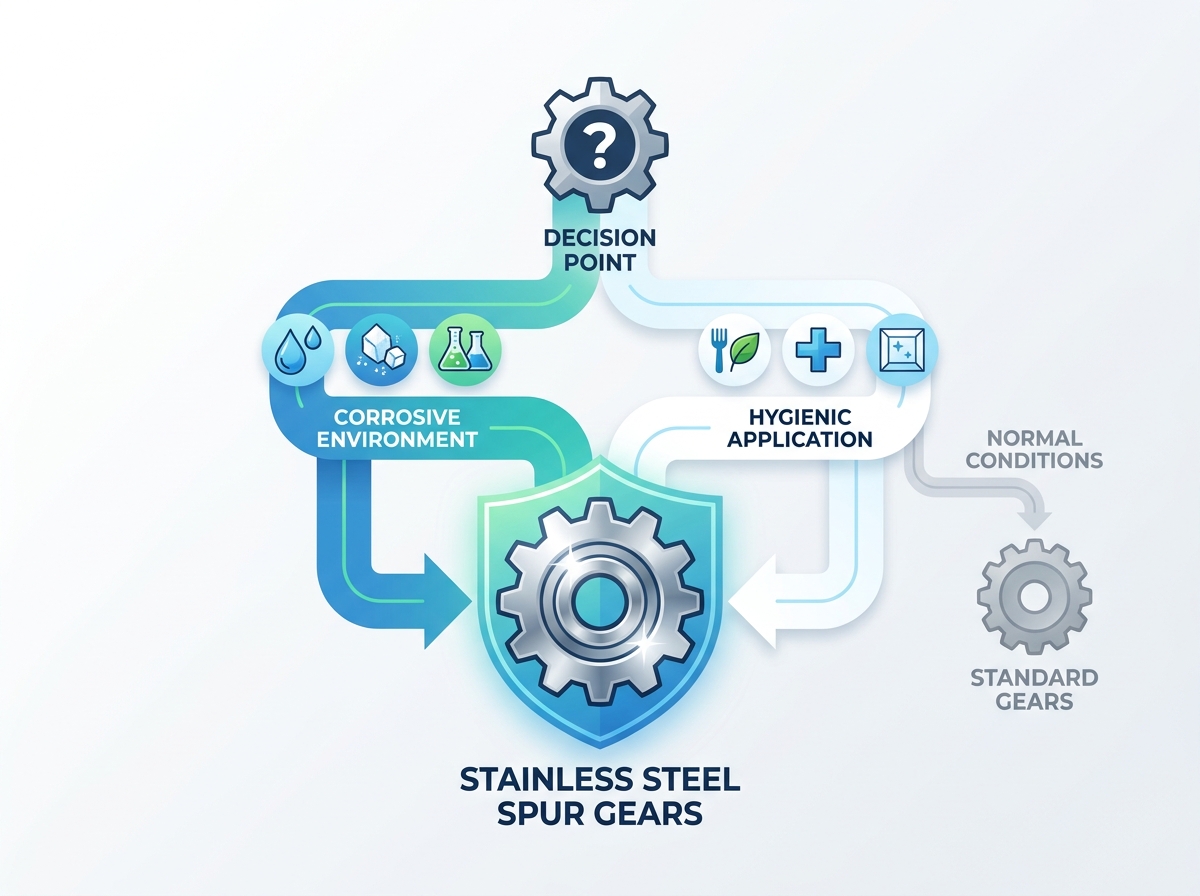
Stainless steel spur gears are a specialized, highly effective solution for corrosive, sterile, or washdown environments. They prevent contamination, resist harsh chemicals, and maintain constant speed ratios on parallel shafts. However, they are not a universal replacement for standard steel or helical gears in high-speed or high-torque applications due to material strength limits and noise generation.
When shortlisting components, apply a strict decision matrix. First, does the environment mandate corrosion resistance? Second, is the operating speed low-to-moderate? Third, can the mechanical load be safely supported by stainless yield strengths? Finally, is a constant speed ratio on parallel shafts required? If the answer to these questions is yes, stainless spur gears are the correct engineering choice.
To move forward with your design or replacement project, take the following actions:
A: Spur gears generally operate best at pitch line velocities under 1,000 feet per minute. Beyond this transition point, the sudden, straight-tooth engagement generates excessive noise and vibration. For high-speed applications exceeding this limit, helical gears are recommended due to their gradual tooth mesh and smoother operation.
A: Spur gears have straight teeth parallel to the shaft. When they mesh, the entire face of the tooth makes contact instantly, causing an impact that generates noise and vibration. Helical gears feature angled teeth that engage gradually, resulting in smoother, quieter operation and a higher load capacity.
A: Galling occurs when identical stainless surfaces slide under pressure. Prevent it by mating gears of dissimilar hardness, such as a 304 gear mating with a 17-4 PH gear. Additionally, apply specialized anti-seize compounds, dry film lubricants, or use continuous lubrication to maintain a protective barrier between the teeth.
A: It depends on the grade. Austenitic grades like 304 and 316 cannot be heat-treated for hardness; they only harden through cold working. Martensitic grades like 416 and 420, along with precipitation-hardening grades like 17-4 PH, can be heat-treated to achieve high surface hardness and strength.
A: The primary difference is the addition of molybdenum in grade 316. This element significantly enhances resistance to pitting and crevice corrosion, particularly in chloride-rich environments like saltwater or harsh chemical washdowns. Grade 304 is sufficient for general moisture and standard food processing applications.
A: Inspection frequency depends on the duty cycle. For continuous industrial use, perform visual inspections monthly and comprehensive checks quarterly. Focus on early detection of pitting, scoring, chips, or excessive backlash. Intermittent operations may only require bi-annual inspections. Always monitor for abnormal noise or vibration.
A: Yes, for specific applications. Engineered plastics offer excellent chemical resistance, operate quietly, and often require no lubrication. However, they have significantly lower load capacities and temperature limits compared to stainless steel. They are ideal for light-duty, low-torque environments requiring corrosion resistance.


